

Pins for Palestine
by Tara Johnston
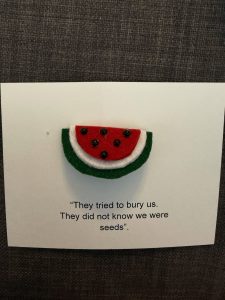 Pins for Palestine is more than an art project—it is a ministry rooted in justice, compassion, and
interfaith solidarity. As a clergy member, my calling is to support people through life’s most
meaningful moments. That same calling compels me to stand with those suffering under
injustice, regardless of faith.
This project embodies interfaith values—our proceeds support Palestinian Muslim families, yet
our buyers and allies come from diverse religious, cultural, and political backgrounds. It
demonstrates that solidarity is universal and that the pursuit of justice transcends faith
traditions.
The watermelon pins are small but powerful reminders that symbols, stories, and acts of
creativity can resist oppression and amplify the voices of the marginalized. In this way, the
project embodies pastoral ministry—not only in word but in action.
Utilization of Funds
The $500 grant was used to cover materials and postage necessary to sustain the Pins for
Palestine initiative. Expenses included felt, beads, fabric glue, brooch pins, and printed
educational leaflets explaining the symbolism of the watermelon. Funds also covered Canada
Post expenses for mailing pins to our Toronto store partner and individuals who ordered through
social media. These resources enabled me to continue creating and distributing pins while
ensuring each one carried both a tangible symbol of solidarity and an educational message.
Ministry & Community Impact
Since launching Pins for Palestine, we have distributed 269 handmade pins, raising
approximately $1,345 to date (August 27, 2025). Proceeds directly supported two families in
Gaza—helping them purchase food when scarcity drove a bag of flour to $650 USD, secure
essential medicine, and repair tents damaged by the harsh realities of displacement.
Our pins are currently available in four Niagara stores (NAC Studio Store, Pampered Peach,
Evergreen Thrift Store, Roly Poly Records) and one Toronto store (Canopy Kids). We also sell
at Niagara Palestine Coalition events and through social media platforms. Remarkably, the
pins have traveled beyond Canada—spotted everywhere from a Toronto concert to a school in
Maryland—demonstrating the reach of grassroots advocacy.
Each pin is accompanied by a leaflet explaining the watermelon as a historic symbol of
Palestinian resistance and solidarity. This simple act of storytelling transforms a small accessory
into a tool for education and awareness, sparking conversations about the ongoing occupation
and human rights violations.
Through this initiative, my ministry takes the form of advocacy, compassion, and presence.
Though I was born in the Middle East, my understanding of Palestine deepened after marrying
my husband—who is half Palestinian and half Jewish—in 2024. Since October 7, 2023, I have
sought to not only learn but also act. This project allows me to channel the helplessness many
feel into tangible solidarity and direct humanitarian relief.
Future Steps & Challenges
Moving forward, I hope to sustain and possibly expand the project, though sustainability remains
a challenge. While demand continues, securing additional store partnerships is difficult due to
limited shelf space and the controversial framing of Palestinian solidarity (though I believe
human rights should never be controversial).
The challenges are real:
● Physical: Handmaking pins while managing carpal tunnel.
● Time: Balancing weddings, community events, and this initiative.
● Emotional: Bearing the weight of advocacy amidst ongoing violence.
● Perception: Overcoming misunderstanding, as many believe this is a “war” when, in
reality, Palestinians lack a military and the majority of casualties are children.
Despite this, I remain committed. With time and resources, Pins for Palestine may expand to an
online shop or additional creative products, though sustainability depends on continued
community support.
Personal Reflection
On a personal level, Pins for Palestine has been a spiritual grounding practice. It helps me cope
with the grief and frustration of watching my tax dollars fund violence against innocent children
and Indigenous people of the land. Each pin I stitch is a prayer, an act of resistance, and a
reminder that even in small ways, we can refuse to be silent.
Conclusion
The Casey & Beverly McKibbon Pastoral Development Award allowed me to continue this
meaningful work by covering essential costs and enabling me to expand the reach of Pins for
Palestine. What began as a personal response to learning and grief has grown into a ministry of
justice, creativity, and community education.
I am deeply grateful for this support, and I remain committed to using my voice, my craft, and
my ministry to advocate for peace, dignity, and compassion for all.