
Little Pieces of Light
by Rev Heidi S. De Jonge
Written for the CSMC website and the Reformed Journal Blog, published Dec 19, 2025
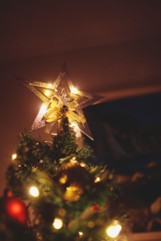
Does every family who puts up a Christmas tree save the topper for the last? We certainly do. It’s usually my job, because my husband won’t come within a few feet of glitter, and our star is glittery.
Every year, I fold over the top branch of our artificial tree and screw the coil base of our star snuggly around it. The star wobbles a bit as I let it go and then settles into the upright-enough position it will hold for the next couple of months. I fuss with the string of lights to make sure some of the coloured bulbs reflect pleasantly off the glitter and the job is done. The tree is decorated.
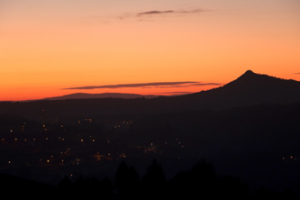 A bright and golden star is a sign of the season, reminding us of the star that led the Magi to the town of Jesus’ birth, and then directly to his house. Several centuries later (813 C.E.) , a hermit named Pelagio saw stars showering down above Pico Sacro – a 530 meter mountain in the Galician region of Spain.
These stars eventually led the Bishop of Iria Flavia (to whom Pelagio reported the sign of the stars) not to a birth place, but to a death place – the resting place of St. James the Greater, one of Jesus’ closest disciples. A small chapel was built, and eventually – to make a centuries-long-story-short – a cathedral. The city surrounding the cathedral is called Santiago de Compostela. Compostela could mean a “well-ordered burial ground,” but many believe that the word comes from the Latin, Campus Stellae: field of stars.
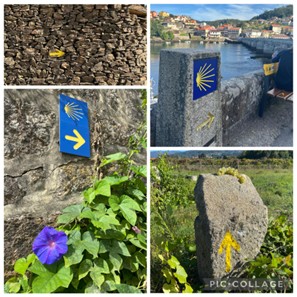 My sister and I, along with our husbands, walked El Camino (The Way) to St. James’s Field of Stars this past September. As we walked, we looked for signs– not stars, but yellow shells and arrows, pointing the way to Santiago.
Also guiding my way was one of two slender volumes I carried with me: Little Pieces of Light by Joyce Rupp. On the mornings that I woke up earlier than my fellow travelers, I would make coffee, find a comfortable place to sit near a lamp, and read a chapter of Rupp’s book. She writes,
“How different the night is when the skies are clear and filled with the radiance of a zillion stars than when the night is cloudy, humid, and filled with the rumblings of an approaching storm. Our inner darkness is no different. It seems to me that the stormy, rumbling night sky is like all those days, months (years, perhaps), when we are overwhelmed with our inner turmoil or emptiness. The radiant star-filled night is like the remarkable and treasurable experience of someone bringing one’s inner starlight into our lives. (pp. 54-55)”
There are many kinds of darkness, aren’t there? And still yet, many more ways of experiencing and perceiving the different kinds of darkness. Rupp invites us into a darkness pierced by little bits of light – a darkness that also holds longing for the morning. “Accepting the darkness but also longing for the light is an immense paradox of our soul’s journey. There will always be a part of us that yearns for the light when we are in the valley of gloom” (p. 56).
I have known this kind of darkness in times of disorientation, when my present vocational situation is the night, words of wisdom from dear friends are the points of light, and the hope for interior and exterior vocational freedom, the longing for morning.
I have known this darkness while supporting a child through an overflow of anxiety – guided by the starry deep breaths and longing for the sun to rise with healing in her wings.
And this darkness surrounded me as I kept vigil at the deathbed of my mother – the star-showers of holding hands and final whispers and releasing tears. The hope for resurrection on the horizon.
My sister and I carried our love and grief for our mother with us as we walked along The Way. We also carried with us the shadows of my sister’s own cancer diagnosis. As bright as our walk was, we were a people walking in darkness.
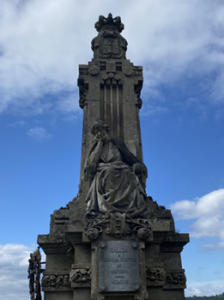
When we arrived in Santiago, I stumbled upon a monument built in honor of Rosalia de Castro, a 19th Century Galician poet. She was born in Santiago in 1837 and died in Padron, Spain (a town through which we had walked) in 1885. She was 48 when she died of cancer. My exact age.
It was Rosalia’s posture in this monument that drew me in. Chin on her hand. Exhausted. Staring off into the middle distance. Her clothes, a bit frumpy. According to Wikipedia, her poetry is marked by saudade – a Portuguese and Galician word whose meaning lies at the intersection of melancholy, nostalgia, and longing. She’s my kind of woman. One of her poems is a tribute to a Black Shadow.
When I think that you have parted,
Black shadow that overshades me,
At the foot of my head pillows
You return making fun of me
And you are the star that shines
And you are the wind that moans
If there’s singing, it’s you that sings,
If there’s weeping, it’s you who weeps,
And you are the river’s rumour
And the night–and the dawn.
Everywhere you are in everything,
For and within me you live
Nor will you ever leave me,
Shadow that always shades me.
The season of advent is a time of black shadows and long nights. Perhaps you find yourself in an oppressive and humid darkness. Or maybe your darkness is lit by a zillion stars. As I gathered my thoughts for this essay, I couldn’t help but think of the book by the poet and cancer survivor, Christian Wiman: My Bright Abyss. May his words (p. 161) pierce your night, as they have pierced mine.
“They need not be only grief, only pain, these black holes in our lives. If we can learn to live not merely with them but by means of them, if we can let them be part of the works of sacred art that we in fact are, then these apparent weaknesses can be the very things that strengthen us. Life tears us apart, but through those wounds, if we have tended them, love may enter us. It may be the love of someone you have lost. It may be the love of your own spirit for the self that at times you think you hate. However it comes through, in all these–of all these and yet more than they, so much more–there burns the abiding love of God.”
May the abiding love of God burn in your life like meteorites descending upon a grave, like a steady star leading to a place of birth, like the sun rising on a longed-for day.